Author

Author: Ankush Shandilya

Ankush Shandilya is a fractional CTO and long-term technology partner, and a co-founder of Behind Methods. He has 15+ years building, scaling, and modernizing software for founder-led SaaS and e-commerce companies in the US, Canada, the UK, and Australia. His clients stay for years. He has been the fractional CTO behind PerkZilla, a US referral-marketing SaaS, since its 2016 launch, and has run a 15-year engineering partnership with Viktoria Professional Movers in Toronto. Earlier work includes Zen Flowchart, which grew past 1.6 million users, and CoinDiscovery, a crypto platform that scaled to 9 million users. He is among the top 3.5% vetted talent on Uplers. He takes on a maximum of two long-term clients at a time, so each one gets one accountable partner, not a rotating agency team.

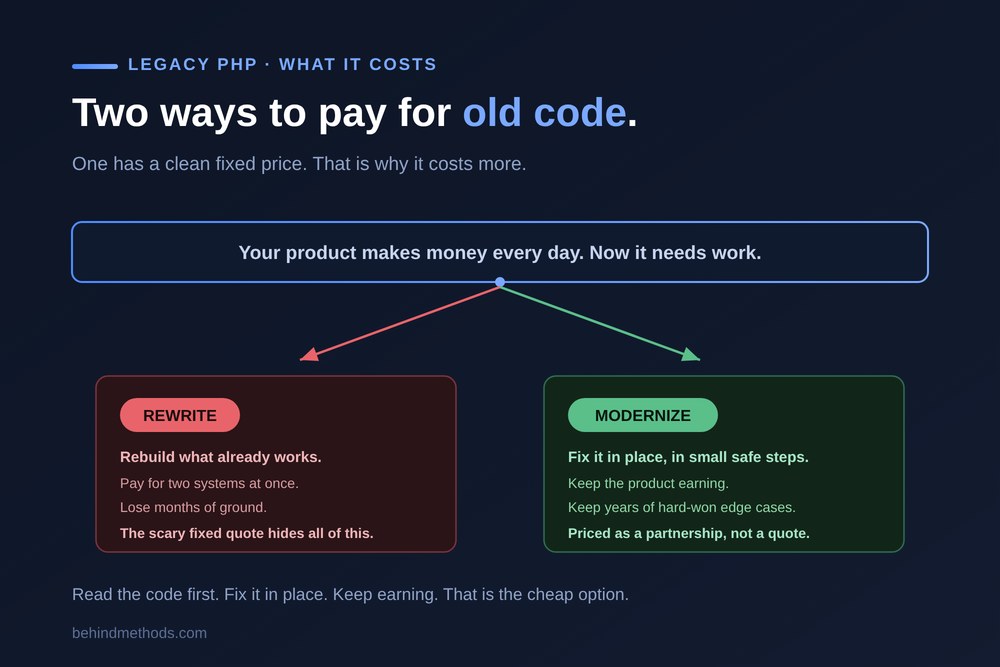
Writing code got cheap. Verifying it did not.

Expert Opinion Jul 09, 2026

Writing code got cheap. Verifying it did not.

AI made writing code cheap this year. It did not make verifying code cheap. The bottleneck moved one step downstream, to the part nobody automated: deciding whether the code is correct, safe, and worth keeping.

Read article
Agentic AI in PHP Is Not a Prototype Idea. It Is a Production Architecture Decision

AI Engineering Mar 12, 2026

Agentic AI in PHP Is Not a Prototype Idea. It Is a Production Architecture Decision

Agentic AI systems in PHP are not a novelty. They are a structured architecture problem… and PHP solves it cleanly when you treat the AI layer as a domain concern, not a script. Neuron AI provides the primitives: agents, tools, memory, and providers. The missing piece most PHP teams skip is governance… clean interfaces, reusable tool registries, and stateless […]

Read article
Decoding the Webpack “Critical Dependency” Warning with sass.dart.js

Coding & Programming Jun 02, 2025

Decoding the Webpack “Critical Dependency” Warning with sass.dart.js

Ever encountered a strange sass.dart.js warning while compiling with Webpack? You're not alone. In this post, Ankush Shandilya from Behind Methods Co breaks down what this warning really means, how to fix or safely ignore it, and why these build-time quirks are great opportunities for technical collaboration—not just frustration.

Read article